

Any provider
Five adapters cover Anthropic Messages, Google Gemini, Azure, the OpenAI Responses passthrough, and every OpenAI-compatible Chat Completions endpoint — plus an 18-provider API-key catalog.
opencodex (ocx) is a local proxy that sits between OpenAI Codex
and any LLM provider. Codex only speaks the Responses API (/v1/responses); opencodex translates
that protocol — in both directions, including streaming, tool calls, reasoning, and images — into
whatever wire format your provider expects, then translates the answer back.
Codex CLI / App / SDK ──/v1/responses──▶ opencodex ──▶ Any provider │ Anthropic · Google · xAI · Kimi · Ollama Cloud · Groq OpenRouter · Azure · DeepSeek · GLM · …and OpenAI itself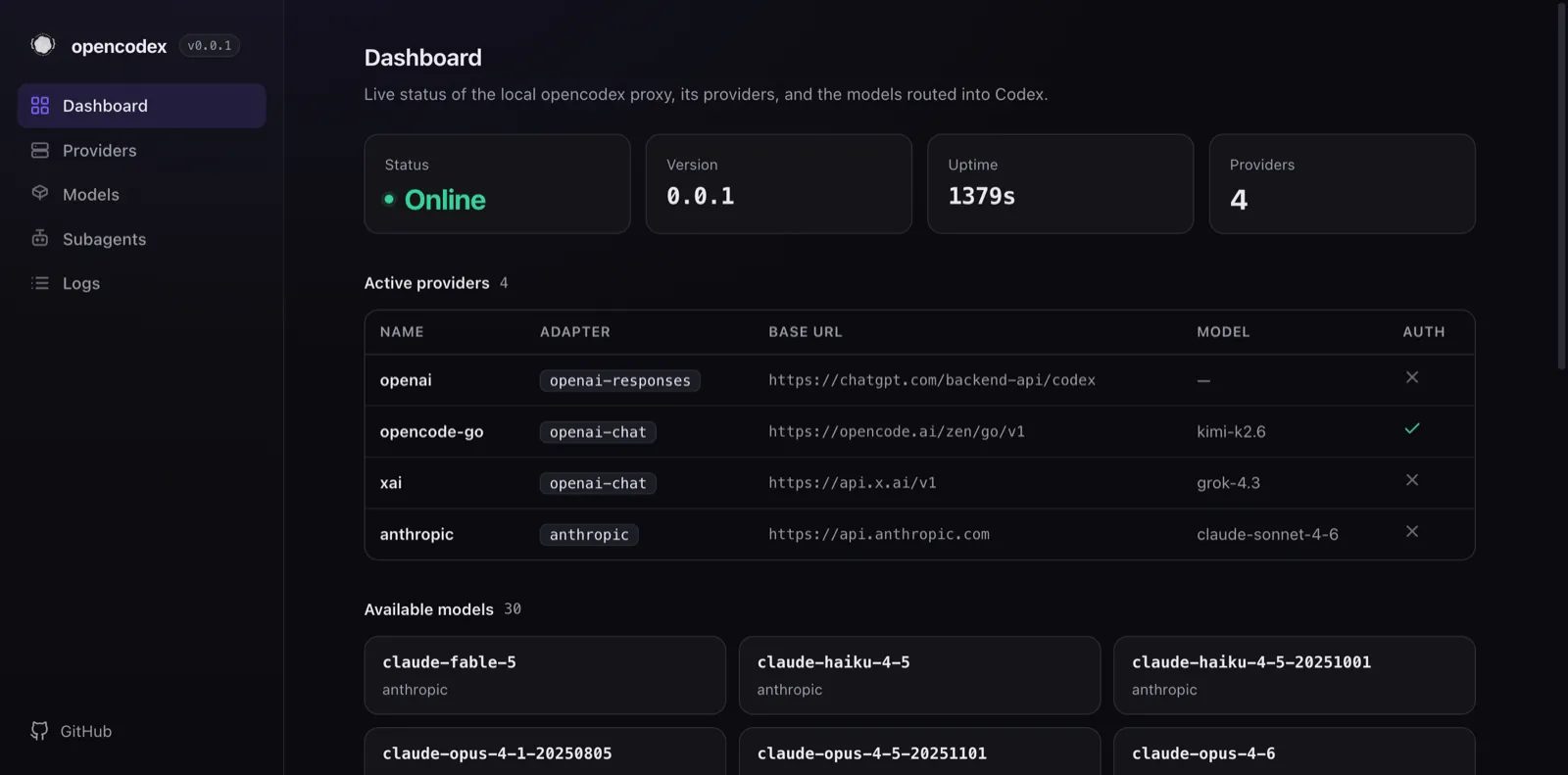
Any provider
Five adapters cover Anthropic Messages, Google Gemini, Azure, the OpenAI Responses passthrough, and every OpenAI-compatible Chat Completions endpoint — plus an 18-provider API-key catalog.
OAuth or API key
Log in with your xAI, Anthropic, or Kimi account (OAuth, auto-refreshed), forward your ChatGPT
login, or paste an API key. Keys can be ${ENV_VARS}.
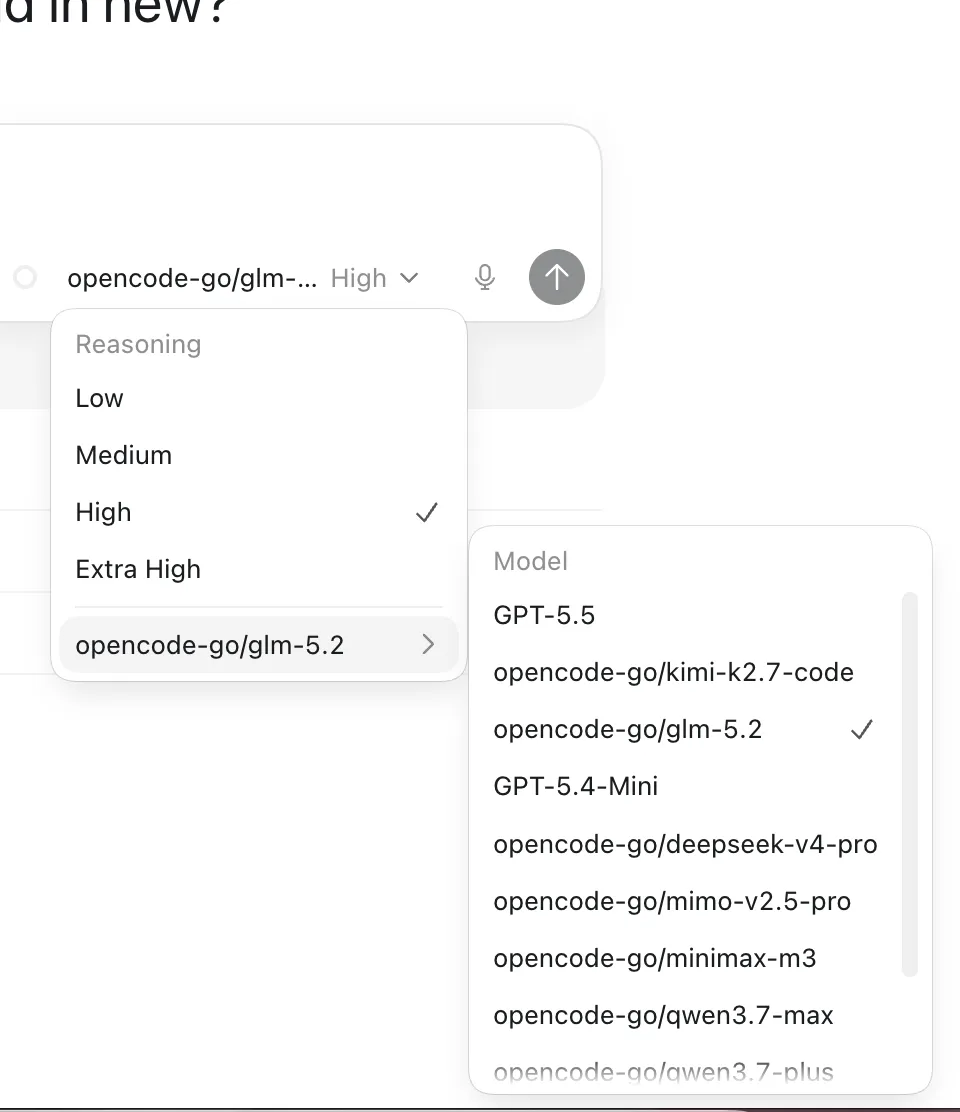
Drops into Codex
ocx init injects a provider into $CODEX_HOME/config.toml (default
~/.codex/config.toml) and writes a shared Codex catalog, so Codex CLI, TUI, App, and SDK
all see the same routed models and subagent picks.
ocx stop restores native Codex cleanly.
Subagents and transports
Pin up to five routed or native models for Codex spawn_agent. HTTP/SSE stays the default;
Responses WebSocket support is advertised only when websockets: true.
Sidecars
Give non-OpenAI models real web search and image understanding by routing those
capabilities through a gpt-5.4-mini sidecar over your ChatGPT login.
# Installbun install -g @bitkyc08/opencodex      # or: npm install -g @bitkyc08/opencodex
# Interactive setup (writes config + injects into Codex)ocx init
# Start the proxyocx start
# Use Codex normally — it now routes through opencodexcodex "Write a hello world in Rust"